Uncheatable Assessments
How to design AI-resistant and cheat-resistant assignments while building cultures of integrity
A self-paced course and workshop for educators.

You can’t detect your way out of cheating, but you can design your way out of it, and it is easier than you think.
Uncheatable Assessments teaches you to design authentic, standards-aligned assignments that resist cheating by their very nature. Instead of policing students, students create work so original, personal, and purposeful that copying or generating it with AI misses the point.
It builds on the book about authentic learning, Storytelling With Purpose , to turn student-created multimedia projects into real evidence of learning in any subject and grade, and is one of the most practical ways to move your Portrait of a Graduate from theory to daily practice. Available as a course or a workshop.

Earn 3 graduate continuing education units (CEUs) from Loyola Marymount University (optional)
How vulnerable are your assignments to cheating with AI?
Use the Cheat Vulnerability Index to find out
Stop policing students and get back to teaching. Here’s how it works.
Upload an existing assignment and my Cheat Vulnerability Index will create a custom report to pinpoint where your assignment may be vulnerable to cheating–with or without AI–and offer solutions.
It’s based on the principles and strategies from my book about authentic learning, Storytelling With Purpose, and my course, Uncheatable Assessments.
Need help implementing these suggestions? Book a discovery call or email me.
WE RESPECT YOUR PRIVACY: Content is never stored or shared, and is deleted immediately after it is processed. Your content is never used to train AI.
How to foster academic integrity in the age of AI
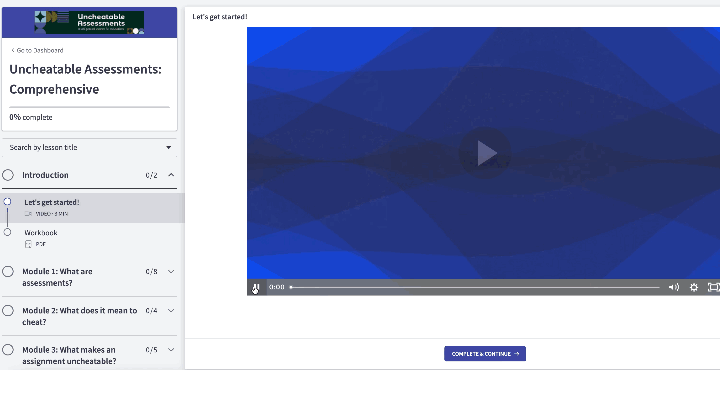
The online course includes 2 hours of video instruction
The 75 page workbook includes activities & templates
.png)
.png)
Why the problem is fixable
Cheating was never the disease. It's a symptom of disengagement. Students take shortcuts when work feels pointless or easy to fake, while teachers burn out policing and schools waste thousands on detection software that is unreliable and biased.
Uncheatable assessments fix the root cause: when students investigate real questions and make something only they could make, integrity becomes a byproduct of work worth doing. You get rigor, engagement, and clear evidence of learning at once.
How it works
The method rests on three pillars: Originality, Personal Connection, and Purpose. You redesign assignments you already teach so students demonstrate their own thinking, connect the work to their lives, and create for a reason beyond a grade. The result is authentic learning artifacts that reveal the process, which is exactly the evidence a Portrait of a Graduate calls for and a traditional test cannot capture.
Is this a lot of work?
No. This is a redesign, not a rebuild. You keep your standards and most of what you already do. Most educators finish the self-paced course in a few hours across several sittings, and in practice spend less time policing and re-grading, not more. You leave with a repeatable process and ready-to-use templates.
Who its for
-
K-12 teachers concerned about engagement and integrity in a world of AI
-
Higher education faculty and adjuncts designing high-impact learning experiences
-
Education leaders wanting to reduce discipline issues and cut spending on biased detection software
-
Coaches and curriculum directors supporting standards-aligned, student-centered design
Uncheatable Assessments Podcast
Listen to my interview with Dr. Monica Burns
What eduators are saying
"One of the most practical and impactful courses I've taken."
Jodie Deinhammer, High School Science Teacher
"A well-designed course."
Donald Sorah, Associate Professor, University of Virginia
Frequently asked questions
What is an uncheatable assessment?
An assignment designed so students must demonstrate and apply their own knowledge, perspective, and creative process in ways that cannot be easily copied or generated by AI. These are real-world performance tasks that reveal the learning process and conclude with original learning artifacts.
Does this mean banning AI?
No. Uncheatable assessments make authentic effort more valuable by emphasizing process and purpose over shortcuts. You decide when and whether AI has a place in the work.
Will this work for any grade level and subject area?
Yes. The design principles apply in every subject and every grade, from elementary through higher education, and the course includes case studies across a range of contexts.
How is this different from cheat-detection software?
Detection tries to catch dishonesty after it happens, and it often flags the wrong students. This prevents the incentive to cheat in the first place by changing how the assignment is designed, so you spend less on software and less time policing.
How long does it take?
The course is self-paced. Most educators finish in a few hours across several sittings.